
Mumbai’s Street Food Scene Is a Culture All Its Own
Before the city fully wakes, the cooking has already begun. In the narrow lanes off Mohammed Ali Road, vendors coax flames beneath iron griddles. The smell of ghee and cumin reaches the street before the stalls are even open. By the time the commuters arrive, the food is ready as it has been, in one form or another, for generations.
Mumbai street food is not a novelty or a side attraction. It is the connective tissue of daily life in one of the world’s most densely inhabited cities. It feeds millions across income levels and communities, holds memory in its recipes, and reflects the layered history of a port city shaped by trade, migration, and reinvention. To eat on the streets of Mumbai is to participate in something that the city’s finest restaurants cannot fully replicate.
The Heart of Mumbai’s Culinary Identity
Mumbai cuisine did not emerge from a single tradition. The city was built by waves of people like Koli fishermen, Parsi merchants, Konkani traders, Gujarati businessmen, and laborers from across the subcontinent. Each bringing ingredients, techniques, and food memories from elsewhere. The street became the place where those traditions met, adapted to one another, and eventually fused into something specific to this city.
Food in Mumbai has always been inseparable from commerce and community. The dabbawala system, which has delivered home-cooked lunches to office workers since the 1890s, speaks to how seriously the city takes its relationship with food. But the street is where that relationship became public, democratic, and constantly evolving.
Origins of Iconic Street Snacks
The most beloved Mumbai dishes carry histories that stretch back decades, sometimes longer.
Vada pav, a spiced potato fritter tucked into a soft bread roll with chutneys, was popularized in the 1960s and 1970s as an affordable, filling meal for mill workers. Ashok Vaidya is widely credited with selling it first near Dadar station in 1966. It became the city’s defining street food not because it was invented for that purpose, but because it answered a genuine need: something hot, satisfying, and portable for a city always moving.
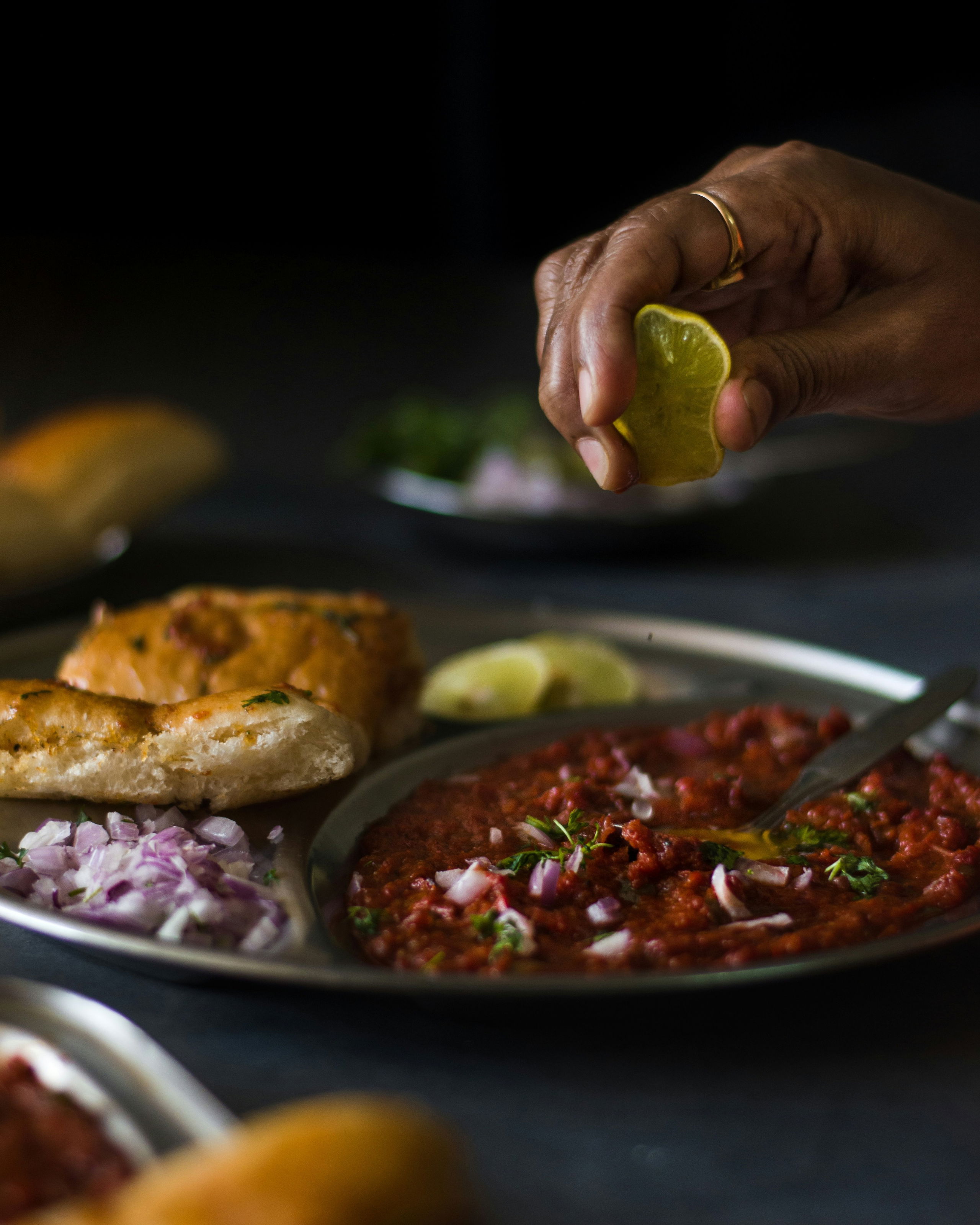
Pav bhaji has a similar working-class origin. The dish, a thick, spiced vegetable mash served with buttered bread rolls, was reportedly developed in the 1850s as a quick meal for textile mill workers who needed to eat during short breaks. The large flat griddles used to prepare it, the tava, became a fixture of Mumbai food stalls across the city.
Bhel puri tells a different story. A mixture of puffed rice, sev, raw onion, tomato, and tamarind chutney, it emerged from the beach hawker culture around Juhu and Chowpatty, where vendors sold light snacks to evening crowds. The dish is assembled to order, its balance of sweet, sour, and spicy adjusted at the vendor’s discretion, which means no two plates are ever quite the same.
Multi-generational vendors are common in Mumbai. Families who have been making the same recipe for forty years are not unusual. In many cases, the technique itself is the inheritance.
The Modern Street Food Revolution
Mumbai’s street food scene is not static. Over the past decade, a younger generation of vendors and restaurateurs has brought new energy to familiar formats without abandoning the flavors that made them essential.
Sandwiches, already a Mumbai institution in the form of the Bombay sandwich (a layered construction of boiled potato, cucumber, beets, and mint chutney on white bread), have been reimagined with different breads, added proteins, and international influences. Pani puri, the hollow crisp shells filled with spiced tamarind water and chickpeas, now appears in variations with flavored waters alongside its traditional form.
Chinese-influenced noodles and Indo-Chinese dishes like Schezwan dosa have become embedded in the street food vocabulary, particularly in areas like Dharavi and around the colleges of South Mumbai. These are not fusions imposed from outside; they are the product of communities that have lived alongside one another for decades, borrowing and adapting without ceremony.
What has not changed is the emphasis on speed, flavor, and the relationship between the vendor and the regular customer. In a city this large, that intimacy remains remarkable.
Where to Find the Best Street Eats in Mumbai
Mumbai’s food geography is precise. Certain dishes belong to certain neighborhoods, certain vendors, certain hours of the day. Knowing where to go is part of eating well here.
- Khau Galli, the name simply means “eating lane” and refers to several concentrated food streets across the city. The Khau Galli near Vile Parle is known for its late-night snacks; the one in Fort area draws office workers at lunch. Each has its own rhythm and roster of dishes.
- Mohammed Ali Road is essential, particularly during Ramadan when the street transforms into a nighttime food market of extraordinary scale. Seekh kebabs, nalli nihari, malpua, and phirni appear alongside the permanent staples. The area’s Muslim food traditions represent one of Mumbai’s most distinct and underappreciated culinary lineages.
- Juhu Beach is where the beach hawker tradition persists. Bhel puri, sev puri, and pani puri vendors line the promenade. The setting—the Arabian Sea at dusk, the sand, the crowd—is part of the meal.
- Chowpatty Beach carries similar energy, with a longer history. The bhelpuri at Chowpatty has its own style, drier than Juhu’s versions, and the vendors here have been feeding the city for generations.
- Crawford Market and the lanes behind it connect Mumbai street vendors selling spices, dried fruits, and street snacks in close proximity to the city’s oldest wholesale markets. Eating here is inseparable from the sensory experience of the market itself.
- Dadar remains the spiritual home of vada pav, with stalls near the station that draw crowds from across the city. The competition between vendors is serious; regulars have allegiances.
Timing Your Visit for Flavor
Mumbai street food is not a single experience spread evenly across the day. The timing of a visit changes everything.
Morning belongs to the idli and dosa vendors offering soft steamed rice cakes and fermented crepes served with sambar and coconut chutney, eaten quickly before the commute. The best versions appear between six and nine in the morning, fresh from the steamer.
Midday is pav bhaji and vada pav territory, particularly near train stations and office clusters. The lunch rush in Mumbai is compressed and intense; the food reflects that pace.
Evening is when the beach hawkers come into their own. The hour before sunset at Juhu or Chowpatty, when the light turns and the crowd thickens, is when the snacking culture of the city is most visible and most social.
Late night—after ten, often past midnight in certain neighborhoods—Mohammed Ali Road and pockets of Bandra become destinations for seekh kebabs, biryani, and haleem. The city’s appetite does not dim with the hour.
Mumbai’s Must-Try Street Food Delicacies
A practical guide to the dishes that define the experience: what to order, what to expect, and why each one matters.
- Vada Pav: The city’s most democratic food. A battered, fried potato dumpling served in a soft pav roll with dry garlic chutney and green chili. Inexpensive, filling, and present on virtually every block.
- Pav Bhaji: A thick, spiced vegetable mash of potatoes, tomatoes, peppers, and peas cooked down on a flat griddle and served with butter-soaked pav rolls. Rich, slightly spicy, and deeply satisfying. One of the most famous foods in Mumbai.
- Bhel Puri: Puffed rice tossed with sev, raw onion, tomato, boiled potato, and tamarind chutney. Eaten with a flat puri cracker. The textures are as important as the flavors.
- Pani Puri: Hollow crisp spheres filled with a mixture of chickpeas, potato, and spiced tamarind water. Eaten in a single bite. One of the defining pleasures of Indian street food.
- Sev Puri: Flat discs of crisp puri topped with potato, onion, chutneys, and fine sev noodles. Closer to a small open-faced snack than a bite, and best eaten immediately after assembly.
- Bombay Sandwich: Layered white bread filled with boiled potato, cucumber, beets, and mint-coriander chutney, toasted on a griddle. A Mumbai original that exists almost nowhere else in quite this form.
- Misal Pav: A Maharashtrian dish of sprouted moth beans in a spiced coconut gravy, topped with farsan and onion, served with pav rolls. Spicy, complex, and often the hottest thing on the table.
- Frankies: A thin whole-wheat roti wrapped around spiced fillings like egg, chicken, paneer, or vegetables with chutney and raw onion. Mumbai’s answer to the wrap, available at roadside stalls across the city.
- Dabeli: A Kutchi specialty that has become a Mumbai staple: mashed potato spiced with a special masala, filled into a pav with peanuts, pomegranate seeds, and sev. Sweet and savory in the same bite.
- Ragda Pattice: Fried potato patties served over white pea curry, garnished with chutneys and sev. One of the more filling options on the street.
Vegetarian Favorites
Mumbai’s vegetarian street food tradition is rooted in the city’s large Gujarati and Jain communities, whose influence on the local cuisine extends far beyond their own neighborhoods. The constraint of vegetarianism has, historically, produced some of the most inventive cooking in Mumbai.
Pani puri, bhel puri, and sev puri are all naturally vegetarian and represent the city’s street food at its most refined in terms of flavor balance. Dosa, while rooted in South Indian tradition, is now deeply embedded in Mumbai street food culture. The masala dosa is prepared at roadside stalls across the city, particularly in neighborhoods with South Indian populations like Matunga, sometimes called “Mini Madras.” Misal pav is among the most beloved examples of Maharashtra street food in a vegetarian format. In Pune it tends toward the very spicy; in Mumbai it is usually tempered slightly, though never mild.
Seafood Specialties
Mumbai is a coastal city, and its relationship with seafood is woven into its oldest food traditions. The Koli community—the city’s original fishing population—brought seafood culture to the streets long before the modern city existed.
Fried fish, often pomfret or surmai (kingfish), marinated in a red masala paste and cooked in a tava, appears at seafood stalls in Sassoon Dock and in the Mahim and Bandra areas. Koliwada shrimp, or prawns coated in a spiced chickpea batter and deep-fried, takes its name from the Koli fishing villages and is now one of the most popular Mumbai delicacies in the city. Raan, a slow-cooked leg of lamb, and various seafood preparations appear along Mohammed Ali Road and in the Muslim neighborhoods of South Mumbai, connecting the city’s street food to a different coastal tradition: the Persian and Arab trade routes that shaped Mughlai cooking in the subcontinent.
Eating Smart: Food Safety and Etiquette
The question of food safety on Mumbai’s streets is real, and it should be addressed directly rather than dismissed.
The most reliable indicator of a safe stall is volume. Vendors who are consistently busy have high ingredient turnover, which means food is rarely sitting for long.
Watch the water. The filled water used in pani puri and similar snacks is a common concern for travelers. If you are uncertain about your tolerance, start with dry snacks like bhel puri, vada pav, or sev puri before moving to dishes that involve liquid. Observe cleanliness at the point of preparation. Is the vendor washing hands or using tongs consistently? Is the cooking surface visibly maintained? These are not guarantees, but they are meaningful signals.
For travelers with more cautious stomachs, the restaurants adjacent to street areas often replicate the same dishes with additional hygiene controls and it is a reasonable way to calibrate before eating from a cart.
Street Food Etiquette 101
Mumbai’s street food culture has its own social grammar, and navigating it well is part of the experience.
- Most stalls operate on a cash basis. Small bills are essential; vendors rarely have change for large denominations. Arriving at a stall and asking for multiple items without having approximate payment ready is considered inconsiderate.
- Ordering is typically direct and fast. Point at what you want, state the quantity, and step aside to let others order while you wait.
- Eating while standing is normal and expected. Seating, where it exists, is often minimal. At beach hawker stalls, the food is designed to be eaten while walking.
- Do not photograph vendors extensively without asking. Many will be happy to have their picture taken; a few will not. A brief gesture of request is usually all it takes.
- Tipping is not customary at street stalls, though rounding up a payment is acceptable and appreciated.
- At communal food areas like Mohammed Ali Road during Ramadan, dressing modestly and being respectful of the religious context of the setting is appropriate. The food is generous and the welcome is warm; arriving with corresponding consideration is the right posture.
The Complete Street Food Experience
There is a version of visiting Mumbai’s street food scene that is organized entirely around what to eat. That version misses something important.
The full experience includes the hour before dinner on Juhu Beach, when the crowd thickens and the smell of pav bhaji from thirty stalls arrives all at once. It includes the specific pleasure of watching a pani puri vendor work: the practiced motion of cracking the shell with a thumb, filling it, and handing it across in a single continuous gesture.
It includes conversations. Mumbai street vendors are, almost universally, communicative. A vendor who has been making the same dish for twenty years has opinions about it; if you express genuine curiosity, you will usually hear them. These exchanges are not performances for tourists. They are the normal texture of how food is discussed in a city where everyone is a regular somewhere.
It includes the sounds: the scrape of a spatula on the griddle, the crack of a puri, the call of a vendor announcing something ready. And the crowds—Mumbai is never quiet, never still—which are not an obstacle to eating but are the context in which the food was designed to be consumed.
Mumbai street food, at its best, is not separable from the city it feeds. Eating it means accepting the pace, the density, the noise, and the warmth as essential ingredients.
Embark on Your Own Street Food Adventure
A first visit to Mumbai’s street food scene benefits from some orientation, but it should not be over-planned. The city rewards a certain willingness to follow your nose—literally—down a lane you hadn’t intended to enter.
For those who want deeper access, traveling with someone who knows the city changes everything. The difference between eating at the right stall and eating at any stall is often invisible from the outside.
India luxury travel with a guide who has spent time building relationships with the people behind the food is a different kind of journey than finding your way alone. The city opens differently when someone can introduce you by name to a vendor who has been making the same bhel puri for thirty years and explain, in the vendor’s own words, why the tamarind ratio matters.
Luxury experiences built around food and culture are designed for this kind of access; not to insulate you from the city, but to bring you more directly into it.
Mumbai travel with culinary experts like Pushkar Marathe, Salil Mehta, or Zahir Khan offers an itinerary built around exactly this kind of engagement: time spent in markets and kitchens, alongside the people who produce the food, with the context to understand what you’re tasting and why it matters.
The city will feed you well on your own. With the right guide, it will show you something worth paying attention to.


