
What Is a Georgian Supra?

A Table Where History Speaks in Toasts
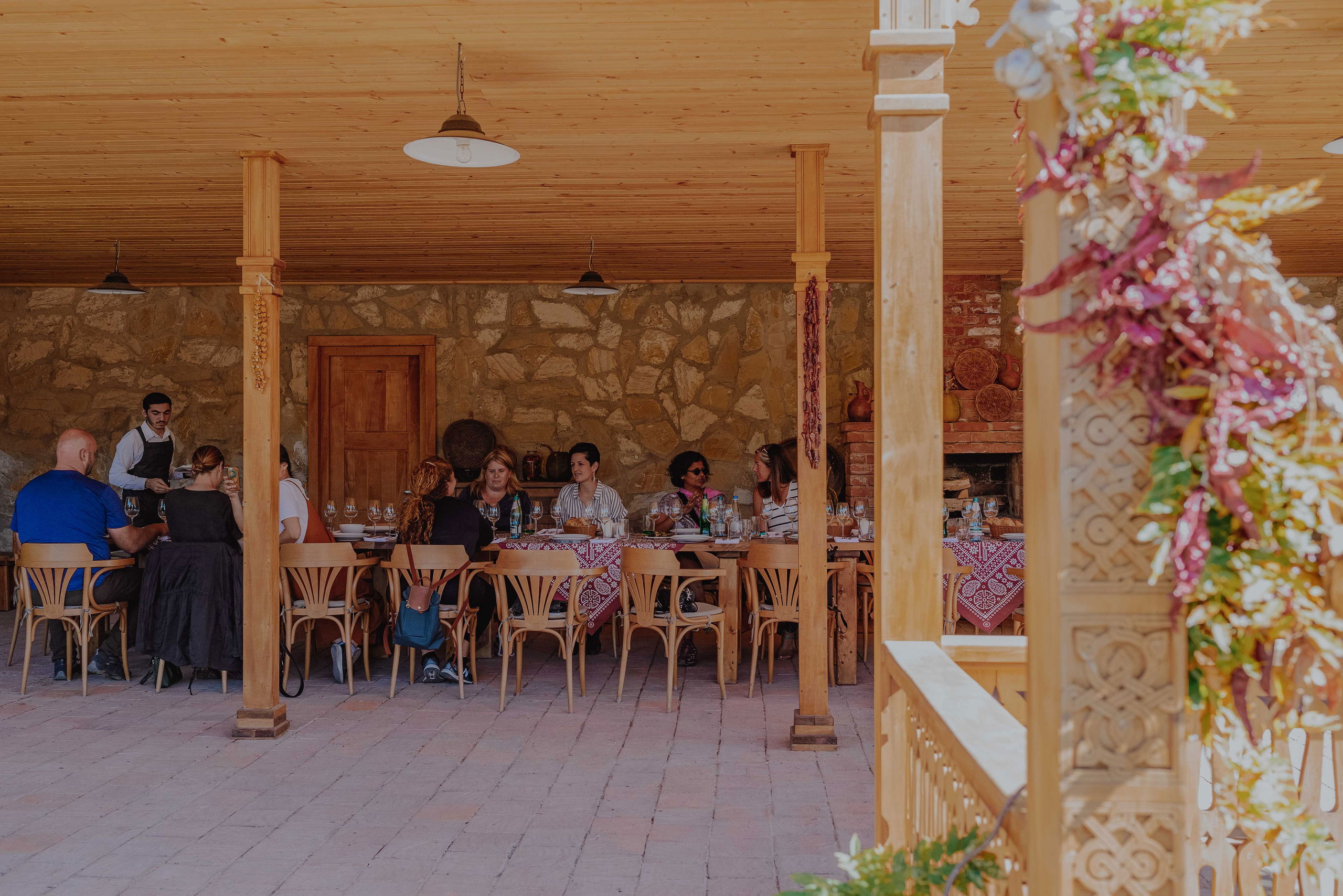
The first sound you notice is not conversation. It is the hollow thud of bread meeting wood.
A round of shotis puri, still warm from a tone oven, lands at the center of a long table in Tbilisi’s Old Town. Its crust crackles as hands tear it open. The air smells of tarragon and walnuts, of grilled meat brushed with pomegranate glaze, of fermenting grapes somewhere nearby in a clay qvevri buried beneath the earth. Glasses are filled, but no one drinks yet.
All eyes turn to the tamada.
He stands slowly, not to command attention, but to gather it. His first toast is not hurried. It is addressed to peace, to ancestors, to the gathering itself. Only after he finishes does anyone lift a glass.
This is a Georgian supra.
To call it dinner would be inaccurate. To call it a feast would be incomplete. A Georgian supra is a choreographed ritual of hospitality, a cultural institution that binds food, wine, poetry, and memory into a single shared experience. It is the axis around which Georgian culinary culture turns.
For those traveling through the Republic of Georgia—particularly on a thoughtfully designed West Georgia tour—the supra offers more than a meal. It offers entry.
A Feast Rooted in History
The word supra simply means “tablecloth” in Georgian. Yet over centuries, the term has come to signify something far larger: a ceremonial feast that marks weddings, funerals, holidays, harvests, and sometimes nothing more than the arrival of honored guests.
Georgia’s location at the crossroads of Europe and Asia has shaped its table. Persian spices, Ottoman techniques, Russian influences, and ancient Caucasian traditions all leave their imprint. Yet the supra predates many of these overlays. It is older than shifting borders. Older than empire.
Wine anchors this continuity. Georgia is widely recognized as one of the oldest wine-producing regions in the world, with archaeological evidence of winemaking dating back 8,000 years. Traditional Georgian wine is fermented and aged in qvevri—large clay vessels buried underground, where grape juice transforms slowly, skins and stems intact. The result is structured, often amber-hued wines with tannic grip and earthy depth. At a supra, Georgian wine is not poured casually. It is introduced through toasts.
Supra and the Geography of Belonging
Georgia’s geography shapes the supra in ways both visible and subtle.
In western Georgia, where rainfall is heavier and greenery more lush, the table reflects abundance. Herbs grow in profusion. Cheese appears frequently. Cornmeal breads accompany many dishes. The Black Sea’s proximity introduces citrus and occasionally fish into the feast.
In eastern Georgia’s Kakheti region, vineyards dominate the landscape. There, a supra might unfold in a winery courtyard, with qvevri lids stacked nearby. Toasts to the harvest carry particular resonance. The wine poured is often made steps away from where the table stands.
In mountainous Svaneti, where winters are long and isolation once common, dishes lean toward preservation. Smoked meats, aged cheeses, and breads designed to sustain appear more prominently. Toasts may reference resilience and endurance—qualities shaped by terrain.
A journey through West Georgia reveals how even within a small country, the supra adapts to place without losing its core identity.
The table is constant. The accent shifts.
The Culinary Philosophy Beneath the Abundance
At first glance, a Georgian supra may seem indulgent. Platters overflow. Wine flows steadily. Toast follows toast. Yet beneath the abundance lies discipline.
Walnut sauces require careful grinding to achieve the right texture. Khinkali dough must be thin enough to hold broth without tearing. Cheese for khachapuri is chosen based on meltability and salt balance. Wine fermentation in qvevri demands attention to timing and temperature, even underground. Nothing is accidental.
On a chef-led Georgia tour—perhaps guided by someone deeply attuned to Eastern European and Caucasian culinary traditions—the mechanics of these dishes come into sharper focus. Guests might visit a local market in Kutaisi where bundles of fresh tarragon scent the air. They may watch an elder fold khinkali with practiced efficiency, each pleat precise. They may descend into a cellar to see qvevri buried in packed earth, their rounded shoulders just visible.
The supra, then, becomes both culmination and classroom.
Why the Supra Endures
In a world where dining often tilts toward speed or spectacle, the Georgian supra persists because it fulfills something more elemental.
It enforces pause. No one rushes a supra. Toasts demand listening. Wine demands attention. The accumulation of dishes resists the idea of a single “main course.” Conversation extends beyond transaction.
In Georgia, hospitality is not performance. It is obligation—and pride. Guests are considered a gift from God in traditional belief. To host well is to honor that gift.
This ethos explains why the supra remains central even as Georgia modernizes. Contemporary Tbilisi restaurants may experiment with plating and natural wines, but when families gather, the structure remains intact. The supra endures because it provides continuity. It ties generations together through repetition.
Georgian Wine as Living Archive
It is impossible to separate the Georgian supra from Georgian wine. When archaeologists uncovered 8,000-year-old qvevri fragments near Tbilisi, they confirmed what Georgians already claimed: that wine is not an import but inheritance.
The method remains largely unchanged. Grapes are crushed and placed into clay vessels buried underground. Skins and stems ferment together with juice. After months, the wine is drawn off, structured and textured, often amber in hue.
At a supra, these wines are not described through tasting notes. They are contextualized through story. A tamada might reference the vineyard’s age. A host may recall the harvest season. A guest might remark on how the wine feels different from European counterparts.
For those traveling on a West Georgia tour that includes visits to small producers, the connection becomes tangible. The same wine tasted in a cellar appears later at a supra table, woven into toasts that reference land and lineage.
Wine becomes memory made liquid.
A Table Worth Crossing Continents For
To ask what is a Georgian supra? is to ask how a culture defines itself at the table. It is feast, yes. But also forum. Ritual. Archive.
It reveals Georgia’s history of invasion and resilience, its agricultural intimacy with land, its insistence that hospitality be participatory rather than performative.
For travelers drawn to nuance, to culinary traditions that predate global homogenization, to wine cultures rooted in earth rather than trend, a Georgia tour centered around the supra offers rare alignment.
On a West Georgia tour with chefs who understand the dialogue between walnut and herb, fermentation and fire, guests sit not as observers but as participants. They witness how dishes accumulate. How toasts unfold. How wine binds strangers.
This journey is designed for those who prefer depth over display. For those who believe that culture reveals itself slowly. For those who understand that the most enduring travel memories are not always panoramic views, but the moment a glass is raised and a room falls silent.
The supra does not end abruptly. It tapers. Toasts soften. Plates empty gradually. At some point, someone begins to sing—polyphonic harmonies rising in layered intervals that feel both ancient and immediate.
The table remains long after the wine is finished. And in that lingering moment, you understand something essential about Georgia. The supra is not performance. It is belonging.


